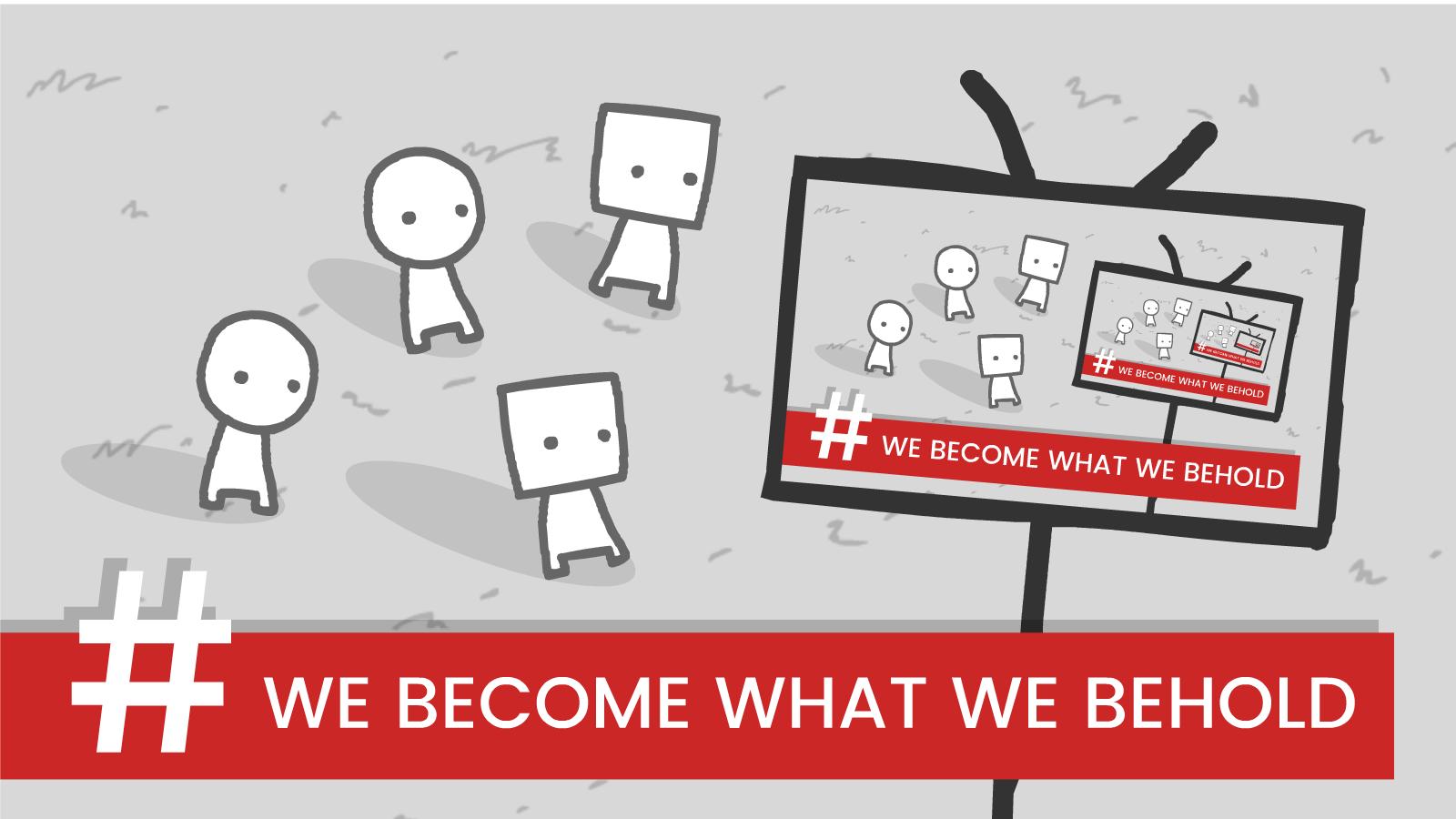





































We Become What We Behold is a short point-and-click experience that delivers a surprisingly powerful social message. You play by photographing simple moments among round and square characters, and those snapshots slowly reshape how the in-game community behaves, creating darkly funny and thought-provoking feedback loops.
A Small Social Experiment in We Become What We Behold
We Become What We Behold was created by developer Nicky Case and first released in October 2016, with an update two years later. This is not an action blockbuster or an elaborate RPG—it’s a delicate sociological vignette that runs for about five minutes and can leave you thinking long after it ends.
One line from the game is central: “We shape our tools, and then our tools shape us.” In this context, the “tools” are cameras and the media they feed.
Minimal Controls, Big Impact
Gameplay is intentionally tiny. You act like an overhead editor: move the mouse, aim, and take photos of the tiny inhabitants below. The scene contains “normal peeps”—quirky figures with square or round heads—going about their day.
Every picture you snap becomes a broadcast item on the in-world “news” TV sitting in the scene. What you choose to show immediately influences how everyone behaves.
From Trendy Hats to Social Breakdown — Gameplay Beats
Fancy Man With The Hat
A stylish figure stands out. Photograph him and the hat quickly becomes a fad—everyone wants one. You started a trend.
When a Trend Grows Old
Keep highlighting hats and attention shifts. Trends fade when overexposed; what was popular becomes boring. You witnessed a fad collapse.
The Lovers
A sweet square-round couple appears. Photographing them should be innocent, yet the TV spins it into shock: “LOVE IS CONTAGIOUS?” The crowd turns to avoidance and ridicule—an example of how media can warp something tender into a scandal.
The Angry Person
A red character starts yelling. A lone outburst is one thing, but when you capture confrontation, the game nudges you: “CATCH ‘EM DOING SOMETHING.” That frame kicks off a full media feeding frenzy.
The Spiral of Negative Coverage
After angry scenes air, the world changes dramatically. Fear and hostility spread faster than fashions. Traits that were once harmless—square versus round heads—become fuel for division.
The more conflict you publish, the more sensational events occur. The loop is simple and brutal: sensational reporting -> public panic and hatred -> more sensational incidents to cover. It races toward a bleak, predictable outcome.
The Message Beneath the Pixels
Media Shapes Reality
The game makes clear that media does more than reflect events; it helps create them. People begin to see the world through what gets broadcast and then start to mimic those behaviors.
Negativity Spreads Quickly
Anger and fear have an outsized appeal; they drown out kinder stories. The in-game line “Who tunes in to watch people get along?” is a pointed critique of attention economics.
The Player’s Responsibility
You, as the player, stand in for journalists, content creators, and social media users. Each photo or share is an editorial choice that nudges society in one direction or another.
Conclusion
We Become What We Behold is a compact social experiment disguised as a short game. Each camera click acts like an editorial decision, and the chain reactions that follow show how small highlights can be inflated into community-wide crises. It’s a sharp reminder of how collective attention can be steered and how easy it is for harmless loops to spiral out of control.